دفترچهٔ فصل ۵: تمرکز نمونهبرداریشده و فاز هندسی
شناسهها: ms-08-metalenses و ms-06-polarization. دو مدل صریحاً جدا داریم: طیف زاویهای اسکالر همگن برای کانون خطی استوانهای و جونز تحلیلی عنصر ناهمسانگرد ایدهآل. میدان دهانهٔ کتابخانهای از ضرایب تناوبی فصل ۵ تقریب موضعی میگیرد؛ فلزنس متناهی تمامموج نیست. جونز، شبیهسازی قطبش ریج TE نیست. بستهٔ کامل، وابستگیها را حفظ میکند.
from pathlib import Path
from dataclasses import replace,asdict
import sys,json,csv,hashlib,platform,html
import numpy as np
import scipy,matplotlib
import matplotlib.pyplot as plt
from IPython.display import display,HTML
ROOT=next((p for p in [Path.cwd(),*list(Path.cwd().parents)[:3]] if (p/'simulations/metasurface_synthesis.py').is_file()),None)
if ROOT is None:raise FileNotFoundError('Extract the Chapter 5 source bundle, preserving simulations/, data/, and notebooks/.')
sys.path.insert(0,str(ROOT/'simulations'))
from unit_cell_te import Cell,solve_cell,sample_ey,phase_error_deg
from metasurface_synthesis import solve_supercell,staircase_coefficients,select_widths,angular_spectrum_1d,rotated_jones,line_fwhm,SOLVER_VERSION
DATA=ROOT/'data/chapter-05';DATA.mkdir(parents=True,exist_ok=True)
def table(headers,rows):
    def escape(x):return html.escape(f'{x:.7g}' if isinstance(x,(float,np.floating)) else str(x))
    display(HTML('<table><thead><tr>'+''.join('<th>'+escape(x)+'</th>' for x in headers)+'</tr></thead><tbody>'+''.join('<tr>'+''.join('<td>'+escape(x)+'</td>' for x in row)+'</tr>' for row in rows)+'</tbody></table>'))
plt.rcParams.update({'figure.dpi':125,'font.size':10,'axes.spines.top':False,'axes.spines.right':False})
print('Python',platform.python_version(),'NumPy',np.__version__,'SciPy',scipy.__version__,'Matplotlib',matplotlib.__version__)

# Editable scalar aperture parameters.
WAVELENGTH_UM=1.55;OUTPUT_INDEX=1.5;FOCAL_DISTANCE_UM=30.
PITCH_UM=.65;N_APERTURE_CELLS=48;APERTURE_UM=PITCH_UM*N_APERTURE_CELLS
DX_UM=.10;N_FFT=2048;FOCUS_WINDOW_HALF_UM=1.;FOCAL_COMPARE_HALF_UM=4.
if not isinstance(N_APERTURE_CELLS,(int,np.integer)) or N_APERTURE_CELLS<2:
    raise ValueError('Use at least two whole aperture cells.')
if not all(np.isfinite(v) and v>0 for v in [WAVELENGTH_UM,OUTPUT_INDEX,FOCAL_DISTANCE_UM,PITCH_UM]):
    raise ValueError('Wavelength, output index, focal distance, and pitch must be finite and positive.')
REFERENCE=Cell(period_um=PITCH_UM,wavelength_um=WAVELENGTH_UM,n_substrate=OUTPUT_INDEX)
REFERENCE.validate()

def require_matching_library(parameters, reference, phase_references, label):
    """Reject reuse outside the saved TE library's experiment and face references."""
    expected=asdict(reference)
    keys=('period_um','wavelength_um','n_ridge','n_gap','n_incident','n_substrate','angle_deg')
    mismatches=[]
    for key in keys:
        actual=parameters.get(key) if isinstance(parameters,dict) else None
        if actual is None or not np.isfinite(actual) or not np.isclose(actual,expected[key],rtol=1e-12,atol=1e-12):
            mismatches.append(f'{key}: saved {actual!r}, requested {expected[key]!r}')
    if phase_references.get('r')!='z=0' or phase_references.get('t')!='z=height':
        mismatches.append('reflection/transmission must be referenced to z=0/z=height')
    if mismatches:
        raise ValueError(f"{label} is incompatible with this experiment: "+'; '.join(mismatches)+
                         '. Generate a matching library before changing its pitch, wavelength, materials, or incidence.')

data=json.loads((DATA/'beam-steering.json').read_text(encoding='utf-8'))
library_metadata=data['metadata']
require_matching_library(library_metadata.get('library_parameters',{}),REFERENCE,
                         library_metadata.get('library_phase_references',{}),'Saved Chapter 5 library')
if (library_metadata.get('time_convention')!='exp(-i omega t)' or
        library_metadata.get('spatial_convention')!='exp(i k.r)'):
    raise ValueError('Saved Chapter 5 library uses incompatible phasor conventions.')
rows=data['extended_library']
print('Aperture width',APERTURE_UM,'um; nominal line-focus distance',FOCAL_DISTANCE_UM,'um')
Python 3.12.1 NumPy 2.4.6 SciPy 1.18.1 Matplotlib 3.11.1
Aperture width 31.200000000000003 um; nominal line-focus distance 30.0 um
۱. فاز عدسی استوانهای را استخراج و نمونهبرداری کنید
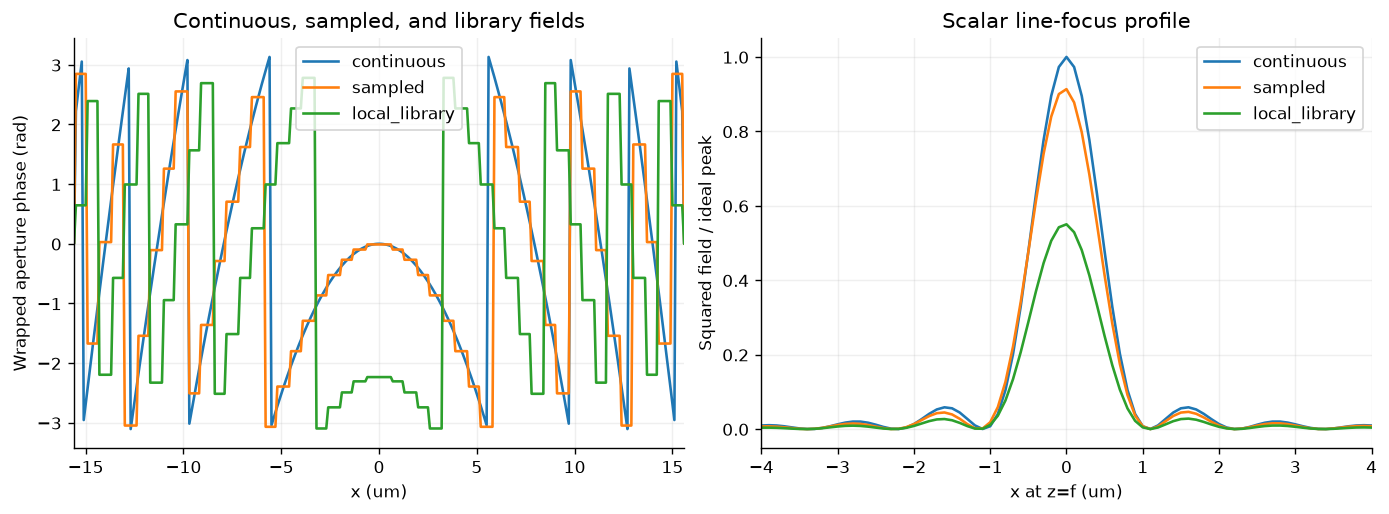
در تابش عمودی، فاز تجمعی در با یکسان میشود. حد پیرامحوری است؛ اینجا فاز اسکالر دقیق را میگیریم. دهانه یکبعدی و کانون خطی در است. میدان پیوسته، فاز نمونهشده در هر گام و میدان کتابخانهای را بسازید. شبکهٔ ثابت آفست، RMS انتخاب را کمینه میکند؛ هیچ سنجهٔ کانون منتشرشده در انتخاب دخالت ندارد.
k=2*np.pi*OUTPUT_INDEX/WAVELENGTH_UM
cell_centers=(np.arange(N_APERTURE_CELLS)+.5)*PITCH_UM-APERTURE_UM/2
phase_cells=-k*(np.sqrt(cell_centers**2+FOCAL_DISTANCE_UM**2)-FOCAL_DISTANCE_UM)
choices=[]
for offset in np.linspace(-np.pi,np.pi,361,endpoint=False):
    selected,error=select_widths(rows,phase_cells,.8,float(offset))
    choices.append((float(np.mean(error**2)),float(offset),selected))
score,phase_offset,selected=min(choices,key=lambda v:v[0])
local_t=np.array([complex(r['t_real'],r['t_imag']) for r in selected])
def validate_focus_grid(dx,n):
    if not np.isfinite(dx) or dx<=0 or not isinstance(n,(int,np.integer)) or n<16 or n%2:
        raise ValueError('Use positive dx and an even integer FFT length of at least 16.')
    half_window=n*dx/2
    if dx>=WAVELENGTH_UM/(2*OUTPUT_INDEX):
        raise ValueError('The grid must resolve the propagating angular-spectrum band.')
    if APERTURE_UM/2+4*dx>=half_window:
        raise ValueError('The physical aperture must fit inside every padded FFT window.')
    if not 0<FOCUS_WINDOW_HALF_UM<FOCAL_COMPARE_HALF_UM<half_window-dx:
        raise ValueError('The fixed integration and comparison regions must fit in every grid without extrapolation.')

def aperture_fields(dx,n):
    validate_focus_grid(dx,n)
    x=(np.arange(n)-n//2)*dx
    gate=abs(x)<APERTURE_UM/2
    bins=np.clip(np.floor((x+APERTURE_UM/2)/PITCH_UM).astype(int),0,N_APERTURE_CELLS-1)
    continuous=np.where(gate,np.exp(-1j*k*(np.sqrt(x*x+FOCAL_DISTANCE_UM**2)-FOCAL_DISTANCE_UM)),0)
    sampled=np.where(gate,np.exp(1j*phase_cells[bins]),0)
    local=np.where(gate,local_t[bins],0)
    return x,dict(continuous=continuous,sampled=sampled,local_library=local)

def fixed_window_integral(x,intensity,half_width):
    """Trapezoidal integral with interpolated endpoints at the same physical +/- width."""
    if -half_width<x[0] or half_width>x[-1]:
        raise ValueError('Requested physical integration interval lies outside the FFT grid.')
    interior=(x>-half_width)&(x<half_width)
    coordinates=np.r_[-half_width,x[interior],half_width]
    values=np.r_[np.interp(-half_width,x,intensity),intensity[interior],np.interp(half_width,x,intensity)]
    return float(np.sum((values[1:]+values[:-1])*np.diff(coordinates)/2))

def focus_metrics(x,field):
    intensity=np.abs(field)**2
    peak=int(np.argmax(intensity))
    fwhm=float(line_fwhm(x,intensity))
    if not np.all(np.isfinite(intensity)) or intensity[peak]<=0 or not np.isfinite(fwhm):
        raise ValueError('Finite, nonzero focus and resolved half-maximum crossings are required.')
    if abs(x[peak])>=FOCAL_COMPARE_HALF_UM or fwhm>=2*FOCAL_COMPARE_HALF_UM:
        raise ValueError('The focal comparison interval does not contain the intended central focus.')
    window_integral=fixed_window_integral(x,intensity,FOCUS_WINDOW_HALF_UM)
    total_integral=float((x[1]-x[0])*np.sum(intensity))  # Periodic discrete norm, not a power-flux claim.
    return dict(fwhm_um=fwhm,peak_intensity=float(intensity[peak]),
                relative_peak=float(intensity[peak]/ideal_peak),
                fixed_window_line_intensity=window_integral,
                line_intensity_per_aperture=float(window_integral/APERTURE_UM),
                total_line_intensity=total_integral,
                line_intensity_fraction=float(window_integral/total_integral))

x,apertures=aperture_fields(DX_UM,N_FFT)
focus={name:angular_spectrum_1d(field,DX_UM,WAVELENGTH_UM,FOCAL_DISTANCE_UM,OUTPUT_INDEX) for name,field in apertures.items()}
# Freeze ONE peak normalization for every aperture model, window, and grid.
ideal_peak=float(np.max(abs(focus['continuous'])**2))
metrics=[dict(model=name,**focus_metrics(x,field)) for name,field in focus.items()]
table(['Scalar aperture model','FWHM (um)','Peak / fixed ideal peak','Fixed-window line intensity / aperture width','Fixed-window / total modeled line intensity'],
      [[r[key] for key in ['model','fwhm_um','relative_peak','line_intensity_per_aperture','line_intensity_fraction']] for r in metrics])
print('All fixed-window integrals use the same physical +/-',FOCUS_WINDOW_HALF_UM,'um boundaries, with interpolated endpoints.')
fig,axes=plt.subplots(1,2,figsize=(11,4),layout='constrained')
for name,field in apertures.items():axes[0].plot(x,np.angle(field),label=name)
axes[0].set(xlim=(-APERTURE_UM/2,APERTURE_UM/2),xlabel='x (um)',ylabel='Wrapped aperture phase (rad)',title='Continuous, sampled, and library fields')
for name,field in focus.items():axes[1].plot(x,abs(field)**2/ideal_peak,label=name)
axes[1].set(xlim=(-4,4),xlabel='x at z=f (um)',ylabel='Squared field / ideal peak',title='Scalar line-focus profile')
for ax in axes:ax.grid(alpha=.2);ax.legend()
plt.show()All fixed-window integrals use the same physical +/- 1.0 um boundaries, with interpolated endpoints.
۲. کنترل انتشار اسکالر
FFT پنجرهٔ محاسباتی تناوبی فرض میکند. مطالعهٔ پنجره فاصلهٔ نمونه را ثابت نگه میدارد و مطالعهٔ شبکه پنجرهٔ فیزیکی را ثابت میکند. هر دو هر سه مدل دهانه را با همان سلولهای انتخابشده و دهانهٔ فیزیکی، فاصلهٔ کانون و ناحیهٔ انتگرالگیری ثابت بازسازی میکنند. حافظهٔ موقت تنظیمهای مشترک را بازاستفاده میکند؛ محاسبهٔ ماکسول تازهای انجام نمیشود.
همهٔ اوجها از اوج اولیهٔ دهانهٔ پیوسته بهعنوان مخرج ثابت مشترک استفاده میکنند. شدت خطی در پنجرهٔ ثابت میان همان انتهاهای فیزیکی با درونیابی انتگرال گرفته و بر عرض فیزیکی دهانه تقسیم میشود تا مقایسهٔ اسکالر به دامنه حساس باشد. تمرکز جداگانهٔ گزارششده همان انتگرال را بر شدت خطی کلِ مدل مربوط تقسیم میکند. FWHM بنا به تعریف از نصف اوج خود هر پروفایل استفاده میکند. هیچیک از این نسبتهای اسکالر بازده فیزیکی توان متمرکزشده نیست.
جدولها همهٔ پالایشها را نگه میدارند و سپس آخرین جفت مستقل هر مدل را کنترل میکنند: تغییر پروفایل کانونی، تغییر نسبی FWHM، تغییر اوج، تغییر شدت خطی پنجرهٔ ثابت و تغییر تمرکز. حدها در کد برای این آزمایش آموزشی اعلام شدهاند؛ عبور از آنها از همین مشاهدهپذیرها در پالایشهای آزمودهشده پشتیبانی میکند و حد پیوستهٔ دقیق یا فلزنس متناهی تمامموج را اثبات نمیکند. کنترل دامنه، دهانه یا ناحیهٔ بزرگتر از پنجره، برونیابی، باند انتشار حلنشده یا کانون بدون عبورهای حلشدهٔ نصف بیشینه را رد میکند.
موج تخت همگن نمونهشده فاز انتشار دقیق دارد و بینهای فوریهٔ منتشرشونده نرم میدان گسسته را حفظ میکنند. این آزمونهای حدی مکمل پالایش مستقل دهانهها هستند و جای آن را نمیگیرند.
# Window changes at fixed dx; grid changes at fixed physical window.
# Every case regenerates all THREE aperture fields with the same selected cells.
study_specs=[('window',[(DX_UM/2,N_FFT),(DX_UM/2,2*N_FFT),(DX_UM/2,4*N_FFT)]),
             ('grid',[(DX_UM,2*N_FFT),(DX_UM/2,4*N_FFT),(DX_UM/4,8*N_FFT),(DX_UM/8,16*N_FFT)])]
comparison_x=np.linspace(-FOCAL_COMPARE_HALF_UM,FOCAL_COMPARE_HALF_UM,1601)
propagation_cache={}
def scalar_case(dx,n):
    key=(float(dx),int(n))
    if key not in propagation_cache:
        xr,fields=aperture_fields(dx,n)
        if comparison_x[0]<xr[0] or comparison_x[-1]>xr[-1]:
            raise ValueError('Do not extrapolate a focal profile beyond its physical FFT domain.')
        cases={}
        for name,field in fields.items():
            propagated=angular_spectrum_1d(field,dx,WAVELENGTH_UM,FOCAL_DISTANCE_UM,OUTPUT_INDEX)
            cases[name]=dict(metrics=focus_metrics(xr,propagated),
                             profile=np.interp(comparison_x,xr,np.abs(propagated)**2))
        propagation_cache[key]=cases
    return propagation_cache[key]

refinements=[];refinement_checks=[]
refinement_limits={
    'window':dict(profile_difference_over_fixed_peak=.02,relative_fwhm_change=.02,
                  peak_change_over_fixed_peak=.02,fixed_window_integral_change_over_aperture=.01,
                  line_concentration_change=.02),
    'grid':dict(profile_difference_over_fixed_peak=.03,relative_fwhm_change=.02,
                peak_change_over_fixed_peak=.03,fixed_window_integral_change_over_aperture=.02,
                line_concentration_change=.02)}
for study,specs in study_specs:
    fine_dx,fine_n=specs[-1]
    reference_cases=scalar_case(fine_dx,fine_n)
    for dx,n in specs:
        cases=scalar_case(dx,n)
        for name,case in cases.items():
            error=float(np.max(np.abs(case['profile']-reference_cases[name]['profile']))/ideal_peak)
            refinements.append(dict(study=study,model=name,dx_um=float(dx),fft_samples=int(n),
                                    window_um=float(dx*n),**case['metrics'],
                                    roi_peak_normalized_difference=error))
    coarse_dx,coarse_n=specs[-2]
    previous_cases=scalar_case(coarse_dx,coarse_n)
    for name,fine in reference_cases.items():
        previous=previous_cases[name];a=previous['metrics'];b=fine['metrics']
        changes=dict(profile_difference_over_fixed_peak=float(np.max(np.abs(previous['profile']-fine['profile']))/ideal_peak),
                     relative_fwhm_change=float(abs(a['fwhm_um']-b['fwhm_um'])/b['fwhm_um']),
                     peak_change_over_fixed_peak=float(abs(a['peak_intensity']-b['peak_intensity'])/ideal_peak),
                     fixed_window_integral_change_over_aperture=float(abs(a['line_intensity_per_aperture']-b['line_intensity_per_aperture'])),
                     line_concentration_change=float(abs(a['line_intensity_fraction']-b['line_intensity_fraction'])))
        passed=all(value<refinement_limits[study][key] for key,value in changes.items())
        refinement_checks.append(dict(study=study,model=name,
            compared_dx_um=[float(coarse_dx),float(fine_dx)],
            compared_windows_um=[float(coarse_dx*coarse_n),float(fine_dx*fine_n)],
            **changes,limits=refinement_limits[study],passed=bool(passed)))

table(['Study','Aperture','dx (um)','Window (um)','FWHM (um)','Peak / fixed ideal peak','Fixed-window integral / aperture','Profile difference / fixed ideal peak'],
      [[r[key] for key in ['study','model','dx_um','window_um','fwhm_um','relative_peak','line_intensity_per_aperture','roi_peak_normalized_difference']] for r in refinements])
table(['Last independent refinement','Aperture','Relative FWHM change','Peak change / fixed peak','Window-integral change / aperture','Concentration change','Pass'],
      [[r[key] for key in ['study','model','relative_fwhm_change','peak_change_over_fixed_peak','fixed_window_integral_change_over_aperture','line_concentration_change','passed']] for r in refinement_checks])
assert {(r['study'],r['model']) for r in refinement_checks}=={(s,m) for s in ['window','grid'] for m in apertures}
assert all(r['passed'] for r in refinement_checks), 'A scalar aperture refinement failed; inspect its recorded changes and retain the failed evidence.'
print('Separate window/grid checks passed for continuous, sampled, and local-library apertures under the recorded demonstration tolerances.')
mode=3;plane=np.exp(2j*np.pi*mode*np.arange(N_FFT)/N_FFT)
kx_mode=2*np.pi*mode/(N_FFT*DX_UM)
exact=plane*np.exp(1j*np.sqrt(k*k-kx_mode*kx_mode)*FOCAL_DISTANCE_UM)
propagated=angular_spectrum_1d(plane,DX_UM,WAVELENGTH_UM,FOCAL_DISTANCE_UM,OUTPUT_INDEX)
assert np.max(abs(propagated-exact))<1e-10
spectrum=np.zeros(N_FFT,complex);spectrum[[0,2,7,-3]]=[1,2j,.4,1-.2j]
test=np.fft.ifft(spectrum);after=angular_spectrum_1d(test,DX_UM,WAVELENGTH_UM,FOCAL_DISTANCE_UM,OUTPUT_INDEX)
assert abs(np.linalg.norm(after)-np.linalg.norm(test))<1e-12
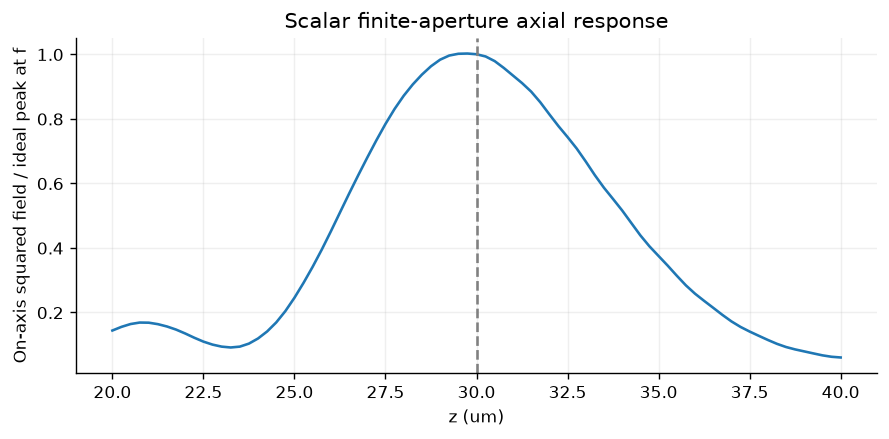
z_scan=np.linspace(20,40,81)
axial=np.array([abs(angular_spectrum_1d(apertures['continuous'],DX_UM,WAVELENGTH_UM,float(z),OUTPUT_INDEX)[N_FFT//2])**2 for z in z_scan])
print('Nominal focus:',FOCAL_DISTANCE_UM,'um; sampled on-axis maximum:',z_scan[np.argmax(axial)],'um (finite-aperture focal shift is possible).')
fig,ax=plt.subplots(figsize=(7,3.4),layout='constrained');ax.plot(z_scan,axial/ideal_peak);ax.axvline(FOCAL_DISTANCE_UM,color='gray',ls='--');ax.set(xlabel='z (um)',ylabel='On-axis squared field / ideal peak at f',title='Scalar finite-aperture axial response');ax.grid(alpha=.2);plt.show()Separate window/grid checks passed for continuous, sampled, and local-library apertures under the recorded demonstration tolerances.
Nominal focus: 30.0 um; sampled on-axis maximum: 29.75 um (finite-aperture focal shift is possible).
۳. جونز و فاز هندسی
در پایهٔ ثابت آزمایشگاه با بگیرید:
ضریب همان پایه و تبدیل به برابر است. نیمموج تبدیل کامل با فاز میدهد.
برای تأخیرانداز بیاتلاف ، کسر تبدیل است. زاویهٔ چرخش دامنهٔ تبدیل بزرگ را تضمین نمیکند. جونز تحلیلی محیط مشترک دارد و پاسخ برداری ریج TE نیست.
angles=np.linspace(0,np.pi,181);retardances=np.linspace(0,np.pi,181)
phase_curves=[];max_jones_error=0.
for sigma in [1,-1]:
    incident=np.array([1,1j*sigma])/np.sqrt(2);converted=np.array([1,-1j*sigma])/np.sqrt(2)
    amplitude=[]
    for theta in angles:
        J=rotated_jones(1.,-1.,float(theta));a=np.vdot(converted,J@incident)
        max_jones_error=max(max_jones_error,float(abs(a-np.exp(2j*sigma*theta))),float(np.linalg.norm(J.conj().T@J-np.eye(2))))
        amplitude.append(a)
    phase_curves.append(np.unwrap(np.angle(amplitude)))
converted_power=[]
incident=np.array([1,1j])/np.sqrt(2);opposite=np.array([1,-1j])/np.sqrt(2)
for delta in retardances:
    J=rotated_jones(np.exp(.5j*delta),np.exp(-.5j*delta),.37)
    converted_power.append(abs(np.vdot(opposite,J@incident))**2)
assert max_jones_error<1e-12
assert max(abs(np.array(converted_power)-np.sin(retardances/2)**2))<1e-12
fig,axes=plt.subplots(1,2,figsize=(10,3.6),layout='constrained')
for sigma,phase in zip([1,-1],phase_curves):axes[0].plot(np.rad2deg(angles),np.rad2deg(phase),label=f'sigma={sigma:+d}')
axes[0].set(xlabel='Element rotation (deg)',ylabel='Unwrapped converted phase (deg)',title='Ideal half-wave geometric phase');axes[0].legend()
axes[1].plot(np.rad2deg(retardances),converted_power);axes[1].set(xlabel='Retardance (deg)',ylabel='Converted fraction',title='Retardance controls conversion')
for ax in axes:ax.grid(alpha=.2)
plt.show()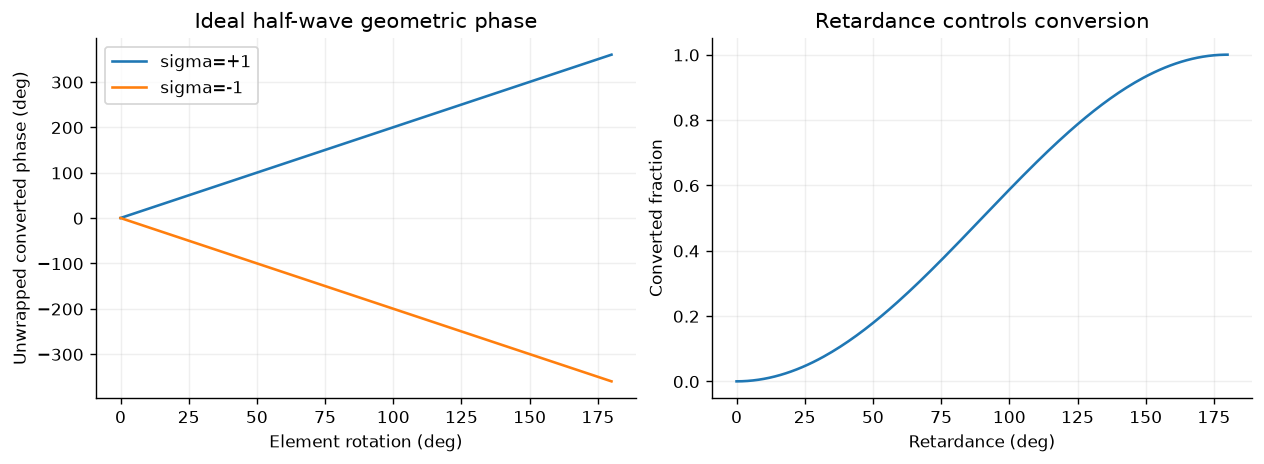
۴. محدودیت مدل کنار سنجه
FWHM و سهم شدت خطی مدل در پنجرهٔ مشخص، سنجهٔ کانون خطی اسکالرند؛ بازده اندازهگیری یا تمامموج، انرژی محصور دوبعدی یا اثبات فلزنس ساختهشده نیستند. پاشندگی فیزیکی، ابیراهی خارجمحور، تحمل ساخت، نشتی قطبش و بررسی ماکسول قطعهٔ متناهی توسعه میخواهند.
summary=dict(model='1D scalar angular spectrum plus separate analytical Jones matrices',aperture_um=APERTURE_UM,focal_distance_um=FOCAL_DISTANCE_UM,wavelength_um=WAVELENGTH_UM,output_index=OUTPUT_INDEX,dx_um=DX_UM,fft_samples=N_FFT,window_um=DX_UM*N_FFT,focus_window_half_um=FOCUS_WINDOW_HALF_UM,metrics=metrics,refinements=refinements,refinement_checks=refinement_checks,focus_comparison_half_um=FOCAL_COMPARE_HALF_UM,metric_normalization=dict(peak='one frozen baseline continuous-aperture peak',fixed_window='same physical endpoints integrated with interpolation',line_intensity='fixed-window integral divided by physical aperture width',concentration='fixed-window integral divided by each model total line intensity',scope='scalar squared-field metrics, not electromagnetic focusing efficiency'),axial_peak_um=float(z_scan[np.argmax(axial)]),max_jones_error=max_jones_error,library_phase_rms_deg=float(np.rad2deg(np.sqrt(score))),source_sha256=hashlib.sha256((ROOT/'simulations/metasurface_synthesis.py').read_bytes()).hexdigest(),limitations=['Cylindrical scalar focus, not a full-wave metalens','Library aperture uses local periodicity','Jones matrices are ideal analytical elements, not the TE ridge','No physical focusing efficiency is reported'])
(DATA/'wavefront-models.json').write_text(json.dumps(summary,indent=2)+'\n',encoding='utf-8')
print('Saved wavefront-models.json; model checks passed.')
Saved wavefront-models.json; model checks passed.
تمرین: فاصلهٔ کانون و عرض دهانه را تغییر و کنترل شبکه و پنجره را تکرار کنید. بیشینهٔ گام فاز و نمونهبرداری، فاز دقیق و پیرامحوری، و اثر شکلدهی دامنه بر اوج و عرض و لوب جانبی با مخرج مشخص را بررسی کنید. تأخیر جونز را تغییر و پوشش فاز را از دامنهٔ تبدیل جدا کنید.
مرجع: Arbabi و همکاران، کنترل فاز و قطبش. ابرسلول ریج، تمرکز اسکالر و جونز تحلیلی سطح شاهد متفاوت دارند و در گزارش باید مشخص بمانند.
- Arbabi, A., Horie, Y., Bagheri, M., & Faraon, A. (2015). Dielectric metasurfaces for complete control of phase and polarization with subwavelength spatial resolution and high transmission. Nature Nanotechnology, 10(11), 937–943. 10.1038/nnano.2015.186