مرتبههای فلوکه: پیشبینی، طبقهبندی و کنترل
دفترچهٔ تحلیلی فصل ۴. فصل، مثالها و آزمایشگاه را ببینید؛ آزمایشگاه مرورگر مستقیم هم دارد.
کانال مجاز، کنترل فرنل و ضریب آرایهٔ تجویزی را محاسبه میکنیم؛ حلگر ماکسول قطعهٔ نقشدار و بازده فراسطح نداریم. بیرون همگن، همسانگرد، بیاتلاف با ضریب حقیقی مثبت است. واحد پیشفرض میکرومتر و درجه است.
هسته را از نو آغاز و همهٔ سلولها را اجرا کنید. پارامترها پاییناند؛ دادهٔ خارجی، GPU و شبکه در اجرا لازم نیست. برای کنترل ژوپیتر requirements-labs.txt و ENABLE_WIDGETS=True؛ مرجع ذخیرهشده False دارد.
۱. پارامتر و محیط
import sys
import json
import numpy as np
import matplotlib
import matplotlib.pyplot as plt
from matplotlib.colors import BoundaryNorm, ListedColormap
from IPython.display import display, HTML
from html import escape

PERIOD_UM, WAVELENGTH_UM = 3.0, 1.55
THETA_DEG, N_IN, N_OUT = 0.0, 1.0, 1.0
CUTOFF_TOL = 1e-10  # tolerance on abs(kx / (n_out*k0)) - 1
NEIGHBOR_ORDERS = 2
MAX_ENUMERATED_ORDERS = 10000
SWEEP_THETA = np.linspace(-70, 70, 281)
SWEEP_WAVELENGTH_UM = np.linspace(0.6, 3.6, 241)
ARRAY_SIZES = (8, 24, 64)
ARRAY_ANGLES_DEG = np.linspace(-89.9, 89.9, 9001)
ENABLE_WIDGETS = False

assert 0 < CUTOFF_TOL < 1e-3
assert isinstance(NEIGHBOR_ORDERS, int) and NEIGHBOR_ORDERS >= 1
assert all(isinstance(n, int) and n > 0 for n in ARRAY_SIZES)
assert np.isfinite(SWEEP_THETA).all() and np.all(np.abs(SWEEP_THETA) < 90)
assert np.isfinite(SWEEP_WAVELENGTH_UM).all() and np.all(SWEEP_WAVELENGTH_UM > 0)
print(f"Python {sys.version.split()[0]}; NumPy {np.__version__}; Matplotlib {matplotlib.__version__}")
print("Convention: exp(-i omega t), exp(i k.r), incidence from z<0; lengths in micrometers.")
print("Evidence: analytical channels, Fresnel interfaces, and prescribed scalar array factors.")

def show_table(headers, rows):
    header = "".join(f'<th scope="col">{escape(str(x))}</th>' for x in headers)
    body = "".join("<tr>" + "".join(f"<td>{escape(str(x))}</td>" for x in row) + "</tr>" for row in rows)
    display(HTML('<div style="overflow-x:auto;max-width:100%"><table><thead><tr>'+
                 header+'</tr></thead><tbody>'+body+'</tbody></table></div>'))
Python 3.12.1; NumPy 2.4.6; Matplotlib 3.11.1
Convention: exp(-i omega t), exp(i k.r), incidence from z<0; lengths in micrometers.
Evidence: analytical channels, Fresnel interfaces, and prescribed scalar array factors.
۲. تعریف محاسبهٔ کانال
مختصهٔ بیبُعد مماسی:
را با یک مقایسه کنید. ریشهٔ فاصلهٔ خروجی در کانال بسته بخش موهومی مثبت دارد. موج بازتابی علامت آزمایشگاهی مخالف دارد، چون خروجی به منفی است.
کران صحیح از میآید. بازهٔ محاطکنندهٔ محافظهکار با همسایهٔ بسته، حذف بیخبر کانال با رشد دوره یا ضریب را پیشگیری میکند. نگهبان شمارش برای آرایهٔ نامعقول خطا میدهد تا حافظه تمام نشود.
نزدیک قطع، طبقه بر رواداری است. گزارششده حد مماسی است، نه باریکهٔ توان عمودی متناهی. اوانسنت زاویهٔ حقیقی نمیگیرد.
def validate_inputs(period_um, wavelength_um, theta_deg, n_in, n_out):
    values = np.array([period_um, wavelength_um, theta_deg, n_in, n_out], dtype=float)
    if not np.isfinite(values).all():
        raise ValueError("All physical parameters must be finite")
    if min(period_um, wavelength_um, n_in, n_out) <= 0:
        raise ValueError("Use positive period, wavelength, and real indices")
    if abs(theta_deg) >= 90:
        raise ValueError("Use an incidence angle strictly between -90 and 90 degrees")

def classify_q(q, n_out, tol=CUTOFF_TOL):
    distance = np.abs(np.asarray(q, dtype=float)/n_out)-1
    return np.where(distance < -tol, "open", np.where(distance > tol, "closed", "grazing"))

def floquet_orders(period_um, wavelength_um, theta_deg, n_in, n_out,
                   neighbors=NEIGHBOR_ORDERS, tol=CUTOFF_TOL):
    validate_inputs(period_um, wavelength_um, theta_deg, n_in, n_out)
    if not isinstance(neighbors, int) or neighbors < 1 or not 0 < tol < 1e-3:
        raise ValueError("Use at least one closed neighbor and a small positive cutoff tolerance")
    q_incident = n_in*np.sin(np.deg2rad(theta_deg))
    step = wavelength_um/period_um
    lower, upper = (-n_out-q_incident)/step, (n_out-q_incident)/step
    # Slightly expand by the classification tolerance so all near-grazing cases are included.
    padding = tol*n_out/step
    first = int(np.floor(lower-padding))-neighbors
    last = int(np.ceil(upper+padding))+neighbors
    if last-first+1 > MAX_ENUMERATED_ORDERS:
        raise ValueError("Too many orders for this teaching notebook; revise the parameter range")
    m = np.arange(first, last+1, dtype=int)
    q = q_incident + m*step
    state = classify_q(q, n_out, tol)
    kz_out_over_k0 = np.sqrt((n_out*n_out-q*q).astype(complex))
    angle = np.full(q.shape, np.nan)
    is_open, is_grazing = state == "open", state == "grazing"
    angle[is_open] = np.rad2deg(np.arcsin(q[is_open]/n_out))
    angle[is_grazing] = np.sign(q[is_grazing])*90
    assert np.all(kz_out_over_k0.real >= 0) and np.all(kz_out_over_k0.imag >= 0)
    return dict(m=m, q=q, state=state, angle_deg=angle,
                kz_out_over_k0=kz_out_over_k0, q_incident=q_incident)

def open_ids(result):
    return result["m"][result["state"] == "open"].tolist()

def print_channels(result, label):
    print(label, "open orders:", open_ids(result))
    show_table(["m", "kx/k0", "State", "Angle (degrees)", "Outward kz/k0"],
               [(int(m), f"{q:.6f}", state, "undefined" if np.isnan(angle) else f"{angle:.4f}", f"{kz:.5g}")
                for m, q, state, angle, kz in zip(result["m"], result["q"], result["state"],
                                                result["angle_deg"], result["kz_out_over_k0"])])

transmitted = floquet_orders(PERIOD_UM, WAVELENGTH_UM, THETA_DEG, N_IN, N_OUT)
reflected = floquet_orders(PERIOD_UM, WAVELENGTH_UM, THETA_DEG, N_IN, N_IN)
print_channels(transmitted, "Transmission region")
print("Reflection region open orders:", open_ids(reflected))
print("All table angles are channel directions; no amplitude or efficiency has been assigned.")
Transmission region open orders: [-1, 0, 1]
Reflection region open orders: [-1, 0, 1]
All table angles are channel directions; no amplitude or efficiency has been assigned.
۳. حالت تحلیلی مستقل
مجموعه و زاویهٔ معلوم، قطع دقیق و دو سو، شاخهٔ میرا، همارزی فاز بلوخ، ورودی نامعتبر و تطبیق با پنجرهٔ صحیح brute-force بسیار بازتر آزموده میشوند. آخری شمارش را میسنجد، نه درستی فیزیک فرمول را بهتنهایی.
مثال مایکروویو و میلیمتر با قرارداد کلاسی متربرثانیه در ۱۰ گیگاهرتز است. تبدیل هر دو به میکرومتر نسبت را عوض نمیکند.
reference = floquet_orders(3, 1.55, 0, 1, 1)
glass = floquet_orders(3, 1.55, 0, 1, 1.5)
primitive = floquet_orders(0.5, 1.55, 0, 1, 1)
assert open_ids(reference) == [-1, 0, 1]
assert open_ids(glass) == [-2, -1, 0, 1, 2]
assert open_ids(primitive) == [0]
assert np.isclose(reference["angle_deg"][reference["m"] == 1][0], 31.10892251052852)
assert np.isnan(reference["angle_deg"][reference["state"] == "closed"]).all()

cutoff_normal = floquet_orders(1.55, 1.55, 0, 1, 1)
assert cutoff_normal["m"][cutoff_normal["state"] == "grazing"].tolist() == [-1, 1]
assert open_ids(cutoff_normal) == [0]
cutoff_deg = float(np.rad2deg(np.arcsin(1.55/0.8-1.5)))
states = []
for offset in (-0.01, 0, 0.01):
    result = floquet_orders(0.8, 1.55, cutoff_deg+offset, 1, 1.5)
    states.append(result["state"][result["m"] == -1][0])
assert states == ["closed", "grazing", "open"]

microwave = floquet_orders(25000, 30000, 20, 1, 1)
assert open_ids(microwave) == [-1, 0]
microwave_angle = float(microwave["angle_deg"][microwave["m"] == -1][0])
assert np.isclose(microwave_angle, -59.09051239302117)
phase_advance = 2*np.pi*(25000/30000)*np.sin(np.deg2rad(20))
multiplier = np.exp(1j*phase_advance)
for m in microwave["m"]:
    assert np.allclose(np.exp(1j*(phase_advance+2*np.pi*m)), multiplier)

closed_index = int(np.flatnonzero(reference["m"] == 2)[0])
alpha_per_um = (2*np.pi/1.55)*reference["kz_out_over_k0"][closed_index].imag
assert alpha_per_um > 0
assert abs(np.exp(-alpha_per_um*2)) < abs(np.exp(-alpha_per_um)) < 1
# Reflected kz=-i*alpha: at z=-s, exp(i*kz*z)=exp(-alpha*s), also decaying.
assert np.isclose(abs(np.exp(1j*(-1j*alpha_per_um)*(-1))), np.exp(-alpha_per_um))

wide_m = np.arange(-200, 201)
for period, wavelength, theta, ni, no in [(3, 1.55, 0, 1, 1), (20, .5, 57, 1.2, 2),
                                         (.8, 1.55, -45, 1, 1.5), (1, 2, 65, 2, 1)]:
    result = floquet_orders(period, wavelength, theta, ni, no)
    q = ni*np.sin(np.deg2rad(theta)) + wide_m*wavelength/period
    expected = wide_m[classify_q(q, no) == "open"].tolist()
    assert open_ids(result) == expected

for invalid in [(0, 1, 0, 1, 1), (1, 1, 90, 1, 1), (1, 1, 0, -1, 1), (1, np.nan, 0, 1, 1)]:
    try:
        floquet_orders(*invalid)
    except ValueError:
        pass
    else:
        raise AssertionError("Invalid physical input was accepted")

validation_report = dict(air_open=open_ids(reference), glass_open=open_ids(glass),
                         primitive_open=open_ids(primitive), microwave_open=open_ids(microwave),
                         first_air_angle_deg=float(reference["angle_deg"][reference["m"] == 1][0]),
                         microwave_negative_angle_deg=microwave_angle,
                         microwave_phase_deg=float(np.rad2deg(phase_advance)),
                         cutoff_glass_deg=cutoff_deg, cutoff_sequence=states,
                         closed_m2_amplitude_decay_length_um=float(1/alpha_per_um))
print("Analytical channel, phase, branch, enumeration, and invalid-input checks passed.")
print(json.dumps(validation_report, indent=2))
Analytical channel, phase, branch, enumeration, and invalid-input checks passed.
{
  "air_open": [
    -1,
    0,
    1
  ],
  "glass_open": [
    -2,
    -1,
    0,
    1,
    2
  ],
  "primitive_open": [
    0
  ],
  "microwave_open": [
    -1,
    0
  ],
  "first_air_angle_deg": 31.10892251052852,
  "microwave_negative_angle_deg": -59.09051239302117,
  "microwave_phase_deg": 102.60604299770061,
  "cutoff_glass_deg": 25.94447977237001,
  "cutoff_sequence": [
    "closed",
    "grazing",
    "open"
  ],
  "closed_m2_amplitude_decay_length_um": 0.9475631587813499
}
۴. نقشهٔ زاویه و طول موج
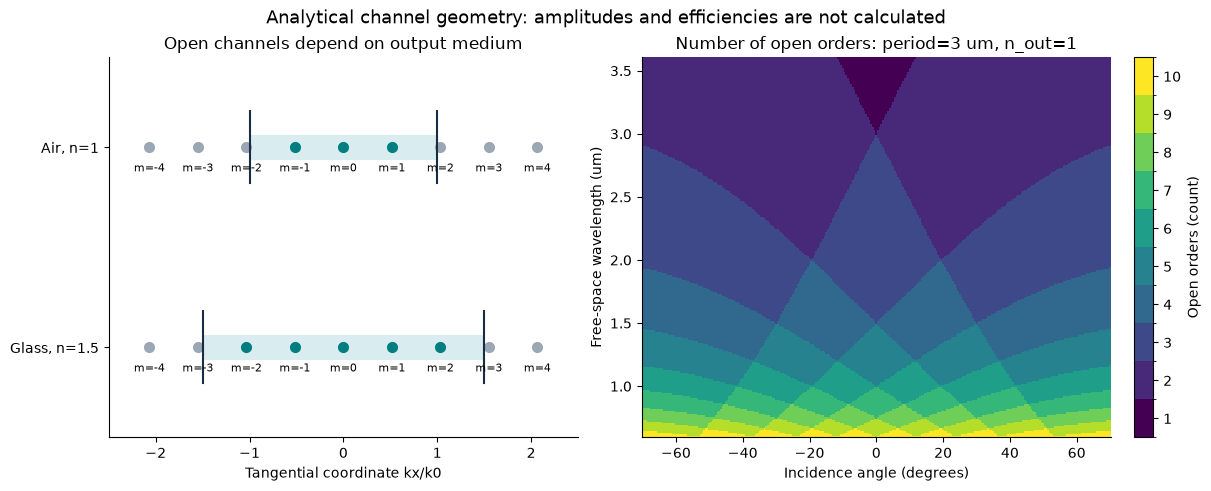
چپ مخروط نور در یک مرجع و راست تعداد مرتبهٔ عبوری باز در جاروب قابلتغییر است. مماسی باز معمولی حساب نمیشود. بازهٔ صحیح از کل جاروب تعیین میشود، نه فقط نقطهٔ شروع. ضریب ثابت فرض تدریس است؛ در مادهٔ پاشنده، ضریب واقعی هر طول موج را بگیرید. نقشهٔ شمار کانال طیف بازده نیست.
plt.rcParams.update({"font.size": 10, "axes.spines.top": False, "axes.spines.right": False})
fig, axes = plt.subplots(1, 2, figsize=(12, 4.8), constrained_layout=True)
ax = axes[0]
for row, (name, no) in enumerate([("Air output", 1.0), ("Glass output", 1.5)]):
    case = floquet_orders(PERIOD_UM, WAVELENGTH_UM, THETA_DEG, N_IN, no)
    ax.plot([-no, no], [row, row], color="#d9edf0", lw=18, solid_capstyle="butt")
    for m, q, state in zip(case["m"], case["q"], case["state"]):
        if abs(q) > 2.5:
            continue
        color = {"open": "#007d80", "grazing": "#b76a00", "closed": "#9ba7b5"}[state]
        ax.plot(q, row, "o", color=color, ms=7)
        ax.text(q, row+0.12, f"m={m}", ha="center", fontsize=8)
    ax.plot([-no, -no], [row-.18, row+.18], color="#182c42")
    ax.plot([no, no], [row-.18, row+.18], color="#182c42")
ax.set(xlabel="Tangential coordinate kx/k0", yticks=[0, 1], yticklabels=["Air, n=1", "Glass, n=1.5"],
       xlim=(-2.5, 2.5), ylim=(-.45, 1.45), title="Open channels depend on output medium")
ax.invert_yaxis()

q_inc = N_IN*np.sin(np.deg2rad(SWEEP_THETA))
step_min = np.min(SWEEP_WAVELENGTH_UM)/PERIOD_UM
max_order = int(np.ceil((N_OUT+np.max(np.abs(q_inc)))/step_min))+NEIGHBOR_ORDERS
if 2*max_order+1 > MAX_ENUMERATED_ORDERS:
    raise ValueError("Sweep requires too many diffraction orders")
count_map = np.zeros((len(SWEEP_WAVELENGTH_UM), len(SWEEP_THETA)), dtype=int)
for m in range(-max_order, max_order+1):
    q = q_inc[None, :] + m*SWEEP_WAVELENGTH_UM[:, None]/PERIOD_UM
    count_map += classify_q(q, N_OUT) == "open"
assert np.isfinite(count_map).all()
levels = np.arange(count_map.min()-.5, count_map.max()+1.5)
cmap = plt.get_cmap("viridis", len(levels)-1)
im = axes[1].pcolormesh(SWEEP_THETA, SWEEP_WAVELENGTH_UM, count_map, shading="auto",
                        cmap=cmap, norm=BoundaryNorm(levels, cmap.N))
axes[1].set(xlabel="Incidence angle (degrees)", ylabel="Free-space wavelength (um)",
            title=f"Number of open orders: period={PERIOD_UM:g} um, n_out={N_OUT:g}")
fig.colorbar(im, ax=axes[1], label="Open orders (count)", ticks=np.arange(count_map.min(), count_map.max()+1))
fig.suptitle("Analytical channel geometry: amplitudes and efficiencies are not calculated", fontsize=13)
plt.show()
۵. کنترل توان با مرز تخت
برای مرز TE غیرمغناطیسی، و روی شاخهٔ خروجی:
عامل بهنجارسازی ضروری است. در بازتاب کلی موهومی، میدان اوانسنت خروجی دارای توان عمودی صفر و است. مرجع تحلیلی مستقل از شبیهسازی توری آینده است؛ جعبهٔ تناوبی مصنوعی به مرز تخت مرتبهٔ غیرآینهای تحمیل نمیکند.
def fresnel_te(n_in, n_out, theta_deg):
    validate_inputs(1, 1, theta_deg, n_in, n_out)
    zi = n_in*np.cos(np.deg2rad(theta_deg))
    q = n_in*np.sin(np.deg2rad(theta_deg))
    zt = np.sqrt(complex(n_out*n_out-q*q))
    r, t = (zi-zt)/(zi+zt), 2*zi/(zi+zt)
    return r, t, float(abs(r)**2), float(zt.real/zi*abs(t)**2)

normal = fresnel_te(1, 1.5, 0)
tir = fresnel_te(1.5, 1, 60)
assert np.allclose(normal, [-.2, .8, .04, .96])
assert np.isclose(tir[2], 1) and np.isclose(tir[3], 0)
max_power_residual = 0.0
for ni, no in [(1, 1.5), (1.5, 1), (1, 1)]:
    for theta in np.linspace(-80, 80, 161):
        _, _, R, T = fresnel_te(ni, no, theta)
        max_power_residual = max(max_power_residual, abs(R+T-1))
assert max_power_residual < 1e-12
show_table(["Interface case", "r (field)", "t (field)", "R (power)", "T (power)"],
           [(name, f"{r:.6g}", f"{t:.6g}", f"{R:.6g}", f"{T:.6g}")
            for name, (r, t, R, T) in [("Normal: 1 to 1.5", normal), ("TIR: 1.5 to 1, 60 deg", tir)]])
print(f"Maximum Fresnel power residual over 483 analytical checks: {max_power_residual:.3e}")
Maximum Fresnel power residual over 483 analytical checks: 4.441e-16
۶. آرایهٔ متناهی، عرض زاویهای متناهی
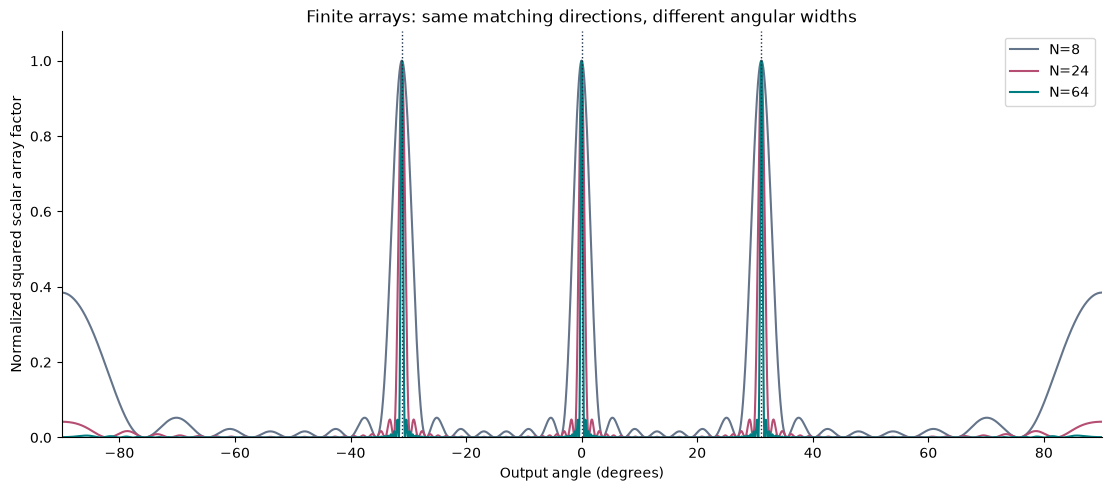
عامل اسکالر را مستقیم حساب کنید:
با لحاظ فاز ورودی، وزن منابع تجویزی و یکسان است؛ الگوی عنصر، کوپل و حل مرزی نداریم. خط عمودی جهت فلوکهٔ باز همان پارامترهاست. مربع مجموع اسکالر بهنجارشده، بازده پراش بهنجارشدهٔ توانی نیست.
def array_factor(theta_deg, n_elements, period_um, wavelength_um, theta_incident, n_in, n_out):
    validate_inputs(period_um, wavelength_um, theta_incident, n_in, n_out)
    phase = (2*np.pi*period_um/wavelength_um)*(
        n_in*np.sin(np.deg2rad(theta_incident))-n_out*np.sin(np.deg2rad(np.asarray(theta_deg))))
    return np.mean(np.exp(1j*np.arange(n_elements)[:, None]*np.atleast_1d(phase)[None, :]), axis=0)

fig, ax = plt.subplots(figsize=(11, 4.8), constrained_layout=True)
for size, color in zip(ARRAY_SIZES, ("#64748b", "#b64d73", "#007d80")):
    factor = array_factor(ARRAY_ANGLES_DEG, size, PERIOD_UM, WAVELENGTH_UM, THETA_DEG, N_IN, N_OUT)
    assert np.max(np.abs(factor)) <= 1+1e-12
    ax.plot(ARRAY_ANGLES_DEG, np.abs(factor)**2, color=color, label=f"N={size}")
for angle in transmitted["angle_deg"][transmitted["state"] == "open"]:
    ax.axvline(angle, color="#182c42", ls=":", lw=1)
    for size in ARRAY_SIZES:
        at_order = array_factor([angle], size, PERIOD_UM, WAVELENGTH_UM, THETA_DEG, N_IN, N_OUT)
        assert np.allclose(np.abs(at_order), 1, atol=1e-12)
ax.set(xlabel="Output angle (degrees)", ylabel="Normalized squared scalar array factor",
       title="Finite arrays: same matching directions, different angular widths", xlim=(-90, 90), ylim=(0, 1.08))
ax.legend()
plt.show()
print("Array-factor values equal one at every open Floquet direction, within floating-point tolerance.")
Array-factor values equal one at every open Floquet direction, within floating-point tolerance.
۷. گسترش به شبکهٔ مستطیلی
برای و سمت تابش :
را با مقایسه کنید، نه فقط . مخروط دایروی جای بازهٔ یکبعدی را میگیرد. مثال همهٔ جفتهای بالقوه باز در کران محافظهکار را میشمارد و توری دوبعدی شبیهسازی نمیکند.
def rectangular_orders(px, py, wavelength, theta, phi, ni, no):
    validate_inputs(px, wavelength, theta, ni, no)
    validate_inputs(py, wavelength, theta, ni, no)
    if not np.isfinite(phi):
        raise ValueError("Azimuth must be finite")
    q = ni*np.sin(np.deg2rad(theta))
    qx0, qy0 = q*np.cos(np.deg2rad(phi)), q*np.sin(np.deg2rad(phi))
    lo_x, hi_x = int(np.floor((-no-qx0)*px/wavelength))-1, int(np.ceil((no-qx0)*px/wavelength))+1
    lo_y, hi_y = int(np.floor((-no-qy0)*py/wavelength))-1, int(np.ceil((no-qy0)*py/wavelength))+1
    if (hi_x-lo_x+1)*(hi_y-lo_y+1) > MAX_ENUMERATED_ORDERS:
        raise ValueError("Too many 2D orders for this teaching example")
    result = []
    for m in range(lo_x, hi_x+1):
        for n in range(lo_y, hi_y+1):
            qx, qy = qx0+m*wavelength/px, qy0+n*wavelength/py
            radius = np.hypot(qx, qy)
            state = str(classify_q(radius, no))
            result.append((m, n, qx, qy, state))
    return result

pairs = rectangular_orders(.8, 1.2, 1.55, 45, 0, 1, 1.5)
open_pairs = {(m, n) for m, n, _, _, state in pairs if state == "open"}
assert open_pairs == {(-1, 0), (0, -1), (0, 0), (0, 1)}
assert {(m, n) for m, n, _, _, s in rectangular_orders(.8, 1.2, 1.55, 45, 0, 1, 1) if s == "open"} == {(0, 0)}
print("Open rectangular-lattice orders in index 1.5:", sorted(open_pairs))
show_table(["m", "n", "kx/k0", "ky/k0", "State"],
           [(m, n, f"{qx:.6f}", f"{qy:.6f}", state) for m, n, qx, qy, state in pairs if state != "closed"])
Open rectangular-lattice orders in index 1.5: [(-1, 0), (0, -1), (0, 0), (0, 1)]
۸. اسلایدر اختیاری ژوپیتر
مرجع ذخیرهشده پیام وضعیت کوتاه دارد. ENABLE_WIDGETS=True را در سلول اول تنظیم، هسته را از نو آغاز و در ژوپیتر اجرا کنید. کنترلها همان floquet_orders را دارند. HTML مستقل آزمایشگاه، تعامل مستقیم بدون هستهٔ پایتون میدهد.
if ENABLE_WIDGETS:
    import ipywidgets as widgets

    def explore(period_um, wavelength_um, theta_deg, n_in, n_out):
        result = floquet_orders(period_um, wavelength_um, theta_deg, n_in, n_out)
        print_channels(result, "Selected output region")

    controls = widgets.interactive(
        explore,
        period_um=widgets.FloatSlider(value=PERIOD_UM, min=.4, max=5, step=.01, description="Period (um)", continuous_update=False),
        wavelength_um=widgets.FloatSlider(value=WAVELENGTH_UM, min=.4, max=4, step=.01, description="Lambda (um)", continuous_update=False),
        theta_deg=widgets.FloatSlider(value=THETA_DEG, min=-75, max=75, step=.5, description="Angle (deg)", continuous_update=False),
        n_in=widgets.FloatSlider(value=N_IN, min=1, max=2.5, step=.05, description="n incident", continuous_update=False),
        n_out=widgets.FloatSlider(value=N_OUT, min=1, max=2.5, step=.05, description="n output", continuous_update=False))
    display(controls)
else:
    print("Reference execution complete. Set ENABLE_WIDGETS=True in Jupyter for sliders, or use the browser explorer in the lab.")
Reference execution complete. Set ENABLE_WIDGETS=True in Jupyter for sliders, or use the browser explorer in the lab.
۹. تفسیر شواهد
مجموعهٔ باز و زاویهٔ علامتدار مثال نوری و مایکروویوی، آزمون قطع، مخرج فرنل و محدودیت آرایه را گزارش کنید. یک مقایسهٔ تمامموج با طرح مرز یا ریج پیشنهاد دهید.
در توسعه، دوره یا خروجی را تغییر، پاشندگی را پیاده یا عامل اسکالر را با الگوی مستند عنصر مقایسه کنید. نتیجهٔ تحلیلی، تجویزی، تمامموج و اندازهگیری را روشن جدا کنید. کانال درست، تحریک پربازدهٔ هدف توسط طرح را ثابت نمیکند.