Topic ID: ms-05-beam-steering. We connect an ideal phase ramp, a discretely
selected periodic-cell library, a local staircase prediction, and a full-wave
TE supercell. Coordinates and signs follow Chapters 3/4: ,
, incidence from , ridges invariant along .
The output is an infinitely repeated six-ridge sequence; it is not a finite
beam deflector or a simulation of cylindrical posts. All ridges in a sequence
share one height. Materials have real constant indices.
The global phase offset is selected using unit-cell phase error alone, before any supercell solve. Full-wave results are verification, not an optimization objective. Browser controls later inspect these saved data; they do not run RCWA.
from pathlib import Path
from dataclasses import replace,asdict
import sys,json,csv,hashlib,platform,html
import numpy as np
import scipy,matplotlib
import matplotlib.pyplot as plt
from IPython.display import display,HTML
ROOT=next((p for p in [Path.cwd(),*list(Path.cwd().parents)[:3]] if (p/'simulations/metasurface_synthesis.py').is_file()),None)
if ROOT is None:raise FileNotFoundError('Extract the Chapter 5 source bundle, preserving simulations/, data/, and notebooks/.')
sys.path.insert(0,str(ROOT/'simulations'))
from unit_cell_te import Cell,solve_cell,sample_ey,phase_error_deg
from metasurface_synthesis import solve_supercell,staircase_coefficients,select_widths,angular_spectrum_1d,rotated_jones,line_fwhm,SOLVER_VERSION
DATA=ROOT/'data/chapter-05';DATA.mkdir(parents=True,exist_ok=True)
def table(headers,rows):
    def escape(x):return html.escape(f'{x:.7g}' if isinstance(x,(float,np.floating)) else str(x))
    display(HTML('<table><thead><tr>'+''.join('<th>'+escape(x)+'</th>' for x in headers)+'</tr></thead><tbody>'+''.join('<tr>'+''.join('<td>'+escape(x)+'</td>' for x in row)+'</tr>' for row in rows)+'</tbody></table>'))
plt.rcParams.update({'figure.dpi':125,'font.size':10,'axes.spines.top':False,'axes.spines.right':False})
print('Python',platform.python_version(),'NumPy',np.__version__,'SciPy',scipy.__version__,'Matplotlib',matplotlib.__version__)

# Editable physical and numerical parameters, in micrometers and degrees.
N_CELLS=6;PITCH_UM=.65;WAVELENGTH_UM=1.55;N_OUTPUT=1.5
REFERENCE=Cell(period_um=PITCH_UM,wavelength_um=WAVELENGTH_UM,n_substrate=N_OUTPUT)
REFERENCE.validate()
HEIGHT_CANDIDATES=[.6,.9,1.2,1.5,1.8]
SCREEN_WIDTHS=np.linspace(.08,.57,50)
EXTENDED_HEIGHT_UM=1.8;WIDTHS=np.linspace(.08,.57,161)
M_LIBRARY,M_LIBRARY_CHECK=24,32
M_FINAL,M_CHECK=144,192
MINIMUM_T=.8;PHASE_ACCEPT_DEG=5.
PERIOD_UM=N_CELLS*PITCH_UM
centers=(np.arange(N_CELLS)+.5)*PITCH_UM
target_phases=2*np.pi*centers/PERIOD_UM
target_sine=(REFERENCE.n_incident*np.sin(np.deg2rad(REFERENCE.angle_deg))+REFERENCE.wavelength_um/PERIOD_UM)/REFERENCE.n_substrate
if abs(target_sine)>=1:raise ValueError('The desired +1 transmitted order must be open; revise period, wavelength, or incidence.')
target_angle=float(np.rad2deg(np.arcsin(target_sine)))
print('Supercell period',PERIOD_UM,'um; desired transmitted order +1 at',target_angle,'degrees.')

def require_matching_library(parameters, reference, phase_references, label):
    """Reject reuse outside the saved TE library's experiment and face references."""
    expected=asdict(reference)
    keys=('period_um','wavelength_um','n_ridge','n_gap','n_incident','n_substrate','angle_deg')
    mismatches=[]
    for key in keys:
        actual=parameters.get(key) if isinstance(parameters,dict) else None
        if actual is None or not np.isfinite(actual) or not np.isclose(actual,expected[key],rtol=1e-12,atol=1e-12):
            mismatches.append(f'{key}: saved {actual!r}, requested {expected[key]!r}')
    if phase_references.get('r')!='z=0' or phase_references.get('t')!='z=height':
        mismatches.append('reflection/transmission must be referenced to z=0/z=height')
    if mismatches:
        raise ValueError(f"{label} is incompatible with this experiment: "+'; '.join(mismatches)+
                         '. Generate a matching library before changing its pitch, wavelength, materials, or incidence.')

def solve_sequence(widths, height_um, half_order):
    cell=replace(REFERENCE,height_um=height_um)
    return solve_supercell(widths,pitch_um=cell.period_um,height_um=cell.height_um,
                           wavelength_um=cell.wavelength_um,n_ridge=cell.n_ridge,n_gap=cell.n_gap,
                           n_incident=cell.n_incident,n_substrate=cell.n_substrate,
                           angle_deg=cell.angle_deg,half_order=half_order)

original_data=json.loads((ROOT/'data/chapter-03/response-library.json').read_text(encoding='utf-8'))
original_metadata=original_data['metadata']
require_matching_library(original_metadata.get('parameters',{}),REFERENCE,
                         original_metadata.get('phase_references',{}),'Saved Chapter 3 library')
if (original_metadata.get('time_convention')!='exp(-i omega t)' or
        original_metadata.get('spatial_convention')!='exp(i k.r)'):
    raise ValueError('Saved Chapter 3 library uses incompatible phasor conventions.')
ORIGINAL_HEIGHT_UM=float(original_metadata['parameters']['height_um'])
original=original_data['rows']
Python 3.12.1 NumPy 2.4.6 SciPy 1.18.1 Matplotlib 3.11.1
Supercell period 3.9000000000000004 um; desired transmitted order +1 at 15.36441349084721 degrees.
1. Extend phase coverage with a common height
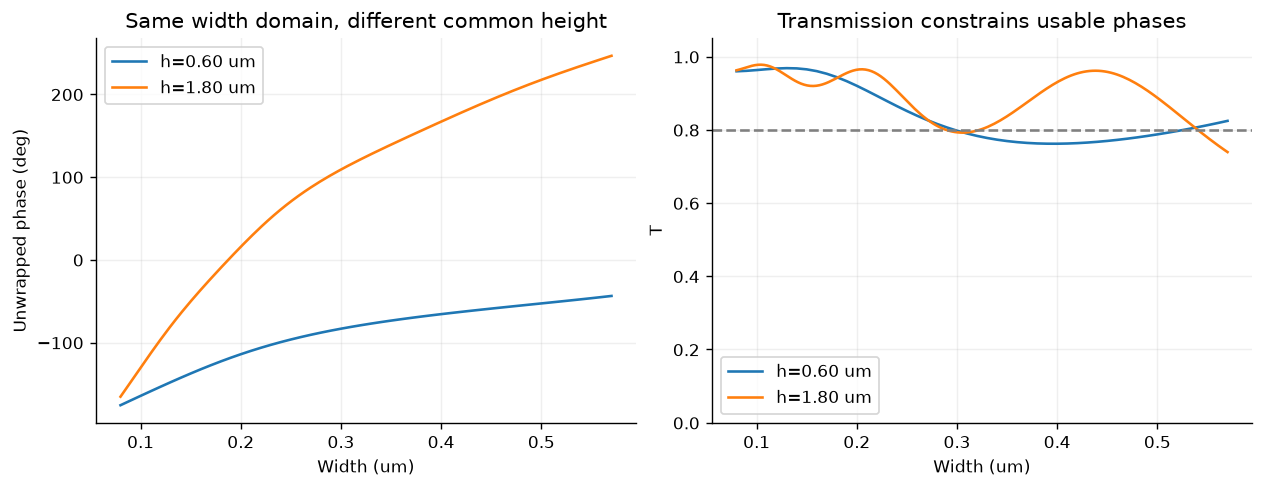
Screen five predeclared heights using the original Chapter 3 width domain. These coarse screening curves are exploratory. The chosen 1.8 um library is recalculated at 161 widths and checked at and 32. Each design uses one fixed height; combining independently referenced heights without a common physical comparison plane is not part of this model.
screen=[]
for height in HEIGHT_CANDIDATES:
    values=[solve_cell(replace(REFERENCE,width_um=float(w),height_um=height),16) for w in SCREEN_WIDTHS]
    t=np.array([v['t'][16] for v in values]);power=np.array([v['T_total'] for v in values])
    screen.append(dict(height_um=height,phase_span_deg=float(np.rad2deg(np.ptp(np.unwrap(np.angle(t))))),minimum_T=float(power.min()),fraction_above_threshold=float(np.mean(power>=MINIMUM_T))))
table(['Height (um)','Sampled phase span (deg)','Minimum T','Fraction with T >= 0.8'],[[r[k] for k in ['height_um','phase_span_deg','minimum_T','fraction_above_threshold']] for r in screen])
extended=[]
for width in WIDTHS:
    c=replace(REFERENCE,height_um=EXTENDED_HEIGHT_UM,width_um=float(width))
    a,b=solve_cell(c,M_LIBRARY),solve_cell(c,M_LIBRARY_CHECK)
    t,r=a['t'][M_LIBRARY],a['r'][M_LIBRARY]
    dt=float(abs(t-b['t'][M_LIBRARY_CHECK]));dp=float(max(abs(a['T_total']-b['T_total']),abs(a['R_total']-b['R_total'])))
    dphi=float(abs(phase_error_deg(t,b['t'][M_LIBRARY_CHECK])))
    extended.append(dict(width_um=float(width),t_real=float(t.real),t_imag=float(t.imag),r_real=float(r.real),r_imag=float(r.imag),T=a['T_total'],R=a['R_total'],phase_deg=float(np.rad2deg(np.angle(t))),delta_t=dt,delta_power=dp,delta_phase_deg=dphi,balance_error=a['balance_error'],accepted=bool(dt<5e-4 and dp<5e-4 and dphi<.05 and a['balance_error']<1e-8)))
assert all(r['accepted'] for r in extended)
print('Extended library:',len(extended),'accepted rows; worst complex refinement',max(r['delta_t'] for r in extended))
fig,axes=plt.subplots(1,2,figsize=(10,3.8),layout='constrained')
for rows,label in [(original,f'h={ORIGINAL_HEIGHT_UM:.2f} um'),(extended,f'h={EXTENDED_HEIGHT_UM:.2f} um')]:
    width=[r['width_um'] for r in rows];t=np.array([complex(r['t_real'],r['t_imag']) for r in rows])
    axes[0].plot(width,np.rad2deg(np.unwrap(np.angle(t))),label=label)
    axes[1].plot(width,[r['T'] for r in rows],label=label)
axes[0].set(xlabel='Width (um)',ylabel='Unwrapped phase (deg)',title='Same width domain, different common height')
axes[1].axhline(MINIMUM_T,color='gray',ls='--');axes[1].set(xlabel='Width (um)',ylabel='T',ylim=(0,1.05),title='Transmission constrains usable phases')
for ax in axes:ax.legend();ax.grid(alpha=.2)
plt.show()Extended library: 161 accepted rows; worst complex refinement 2.1344101538935203e-05
2. Quantize a ramp and select actual geometries
The target produces positive order under our Fourier convention. At each candidate global offset, choose the nearest circular phase among accepted rows with . Minimize the mean squared phase error across the six positions over a fixed 361-offset grid. The global offset changes which geometries are selected, although adding a constant to an ideal continuous phase profile does not change its beam direction.
def choose(rows):
    trials=[]
    for offset in np.linspace(-np.pi,np.pi,361,endpoint=False):
        selected,error=select_widths(rows,target_phases,MINIMUM_T,float(offset))
        trials.append((float(np.mean(error**2)),float(offset),selected,error))
    score,offset,selected,error=min(trials,key=lambda x:x[0])
    return dict(offset_rad=offset,selected=selected,errors_deg=np.rad2deg(error).tolist(),rms_phase_error_deg=float(np.rad2deg(np.sqrt(score))))
limited,expanded=choose(original),choose(extended)
table(['Library height (um)','Global offset (deg)','RMS phase error (deg)','Maximum error (deg)','All targets within 5 deg'],[[height,np.rad2deg(v['offset_rad']),v['rms_phase_error_deg'],max(abs(np.array(v['errors_deg']))),bool(max(abs(np.array(v['errors_deg'])))<=PHASE_ACCEPT_DEG)] for height,v in [(ORIGINAL_HEIGHT_UM,limited),(EXTENDED_HEIGHT_UM,expanded)]])
table(['Position','Width (um)','Local T','Phase error (deg)'],[[j,r['width_um'],r['T'],expanded['errors_deg'][j]] for j,r in enumerate(expanded['selected'])])
assert max(abs(np.array(expanded['errors_deg'])))<PHASE_ACCEPT_DEG3. Compare a local mask with a full-wave supercell
The local prediction assumes a constant complex field coefficient in each pitch-wide interval. Its exact Fourier coefficient includes the finite sample width: . Using gives a local-mask power estimate. It need not conserve energy because neighboring elements and boundary matching were not solved together. The RCWA supercell instead matches Maxwell fields for the complete repeated geometry. It includes all open orders on both sides.
case_specs=[('limited',ORIGINAL_HEIGHT_UM,limited['selected']),('expanded',EXTENDED_HEIGHT_UM,expanded['selected']),
            ('uniform',EXTENDED_HEIGHT_UM,[min(extended,key=lambda r:abs(r['width_um']-REFERENCE.period_um/2))]*N_CELLS),
            ('reversed',EXTENDED_HEIGHT_UM,expanded['selected'][::-1])]
cases=[];raw={}
for name,height,selected in case_specs:
    widths=[r['width_um'] for r in selected]
    result=solve_sequence(widths,height,M_FINAL)
    check=solve_sequence(widths,height,M_CHECK)
    ct=staircase_coefficients([complex(r['t_real'],r['t_imag']) for r in selected],result['orders'])
    cr=staircase_coefficients([complex(r['r_real'],r['r_imag']) for r in selected],result['orders'])
    lpaT=result['qt'].real/result['qi'][M_FINAL].real*abs(ct)**2
    lpaR=result['qi'].real/result['qi'][M_FINAL].real*abs(cr)**2
    open_either=(result['qi'].real>0)|(result['qt'].real>0)
    rows=[]
    for index in np.where(open_either)[0]:
        m=int(result['orders'][index]);j=m+M_CHECK
        rows.append(dict(m=m,reflection_open=bool(result['qi'][index].real>0),transmission_open=bool(result['qt'][index].real>0),R=float(result['R'][index]),T=float(result['T'][index]),local_R=float(lpaR[index]),local_T=float(lpaT[index]),t_real=float(result['t'][index].real),t_imag=float(result['t'][index].imag),delta_T=float(abs(result['T'][index]-check['T'][j])),delta_R=float(abs(result['R'][index]-check['R'][j])),delta_complex_t=float(abs(result['t'][index]-check['t'][j]))))
    assert max(r['delta_T'] for r in rows)<1e-4 and max(r['delta_R'] for r in rows)<1e-4
    assert max(r['delta_complex_t'] for r in rows if r['transmission_open'])<1e-4
    assert result['balance_error']<1e-8
    target=next(r for r in rows if r['m']==1)
    record=dict(name=name,height_um=height,widths_um=widths,local_t=[[r['t_real'],r['t_imag']] for r in selected],orders=rows,R_total=result['R_total'],T_total=result['T_total'],target_T=target['T'],conditional_target_fraction=target['T']/result['T_total'],local_target_T=target['local_T'],local_balance=float(lpaT.sum()+lpaR.sum()),balance_error=result['balance_error'])
    cases.append(record);raw[name]=result
table(['Design','T(+1), incident-normalized','T(+1)/Ttotal','Local-mask T(+1)','Rtotal','Ttotal','Local R+T'],[[v[k] for k in ['name','target_T','conditional_target_fraction','local_target_T','R_total','T_total','local_balance']] for v in cases])
table(['Order','R','T','Local R estimate','Local T estimate','Delta T: 144 to 192'],[[r[k] for k in ['m','R','T','local_R','local_T','delta_T']] for r in cases[1]['orders']])
assert cases[2]['target_T']<1e-12
assert abs(next(r['T'] for r in cases[3]['orders'] if r['m']==-1)-cases[1]['target_T'])<1e-10
fig,axes=plt.subplots(1,2,figsize=(11,4),layout='constrained')
orders=[r['m'] for r in cases[1]['orders']]
axes[0].bar(np.array(orders)-.18,[r['local_T'] for r in cases[1]['orders']],width=.36,label='Local staircase estimate')
axes[0].bar(np.array(orders)+.18,[r['T'] for r in cases[1]['orders']],width=.36,label='Full-wave supercell')
axes[0].set(xlabel='Transmitted order',ylabel='Incident-normalized estimate / power',title='Expanded library: geometry interactions matter');axes[0].legend()
for case in cases:axes[1].plot(orders,[r['T'] for r in case['orders']],'o-',label=case['name'])
axes[1].set(xlabel='Transmitted order',ylabel='Full-wave transmitted power',title='Limited, expanded, identical, and reversed sequences');axes[1].legend()
plt.show()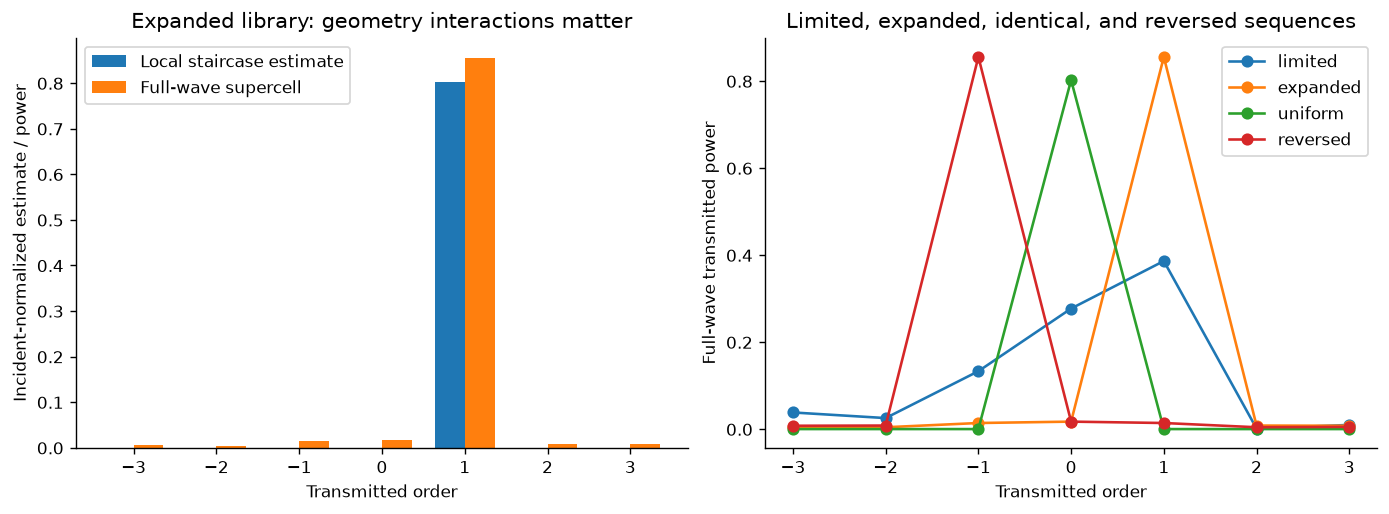
4. Refine the Fourier bandwidth
As a supercell grows, keeping the same integer reduces the maximum represented physical transverse wavevector. The calculation below holds the six-cell geometry fixed and refines . The final 144/192 comparison is already applied to every reported open-order power and complex transmitted amplitude for all four cases. Power conservation and convergence are reported independently.
convergence=[]
for M in sorted(set([12,24,36,48,72,96,M_FINAL])):
    result=solve_sequence(cases[1]['widths_um'],cases[1]['height_um'],M)
    convergence.append(dict(M=M,harmonics=2*M+1,target_T=float(result['T'][M+1]),delta_target_vs_check=0.,balance_error=result['balance_error']))
# Use a fresh explicit high-order target for signed-difference-independent errors.
high=solve_sequence(cases[1]['widths_um'],cases[1]['height_um'],M_CHECK)
for row in convergence:row['delta_target_vs_check']=abs(row['target_T']-float(high['T'][M_CHECK+1]))
table(['M','Harmonics','T(+1)',f'Difference vs M={M_CHECK}','Power residual'],[[r[k] for k in ['M','harmonics','target_T','delta_target_vs_check','balance_error']] for r in convergence])5. Reconstruct the deflected field
The plot covers two repeated supercells and uses the full modal solution at . It illustrates the coherent field, including interference and near-field structure. The separately computed modal powers establish the far-field order fractions. This picture does not model an aperture edge or a finite incident beam.
result=raw['expanded']
x=np.linspace(0,2*PERIOD_UM,361);z=np.linspace(-.35,result['cell'].height_um+5,301)
field=sample_ey(result['cell'],result,x,z)
fig,ax=plt.subplots(figsize=(9,5.2),layout='constrained')
image=ax.pcolormesh(x,z,field.real,shading='auto',cmap='RdBu_r');fig.colorbar(image,ax=ax,label='Re(Ey/Einc)')
for repeat in [0,1]:
    for center,width in zip(centers+repeat*PERIOD_UM,cases[1]['widths_um']):ax.add_patch(plt.Rectangle((center-width/2,0),width,result['cell'].height_um,fill=False,color='black',lw=.7))
ax.axhline(result['cell'].height_um,color='black',lw=.7);ax.invert_yaxis();ax.set(xlabel='x (um)',ylabel='z (um)',title=f'Full-wave repeated supercell; +1 order at {target_angle:.2f}° in the substrate')
plt.show()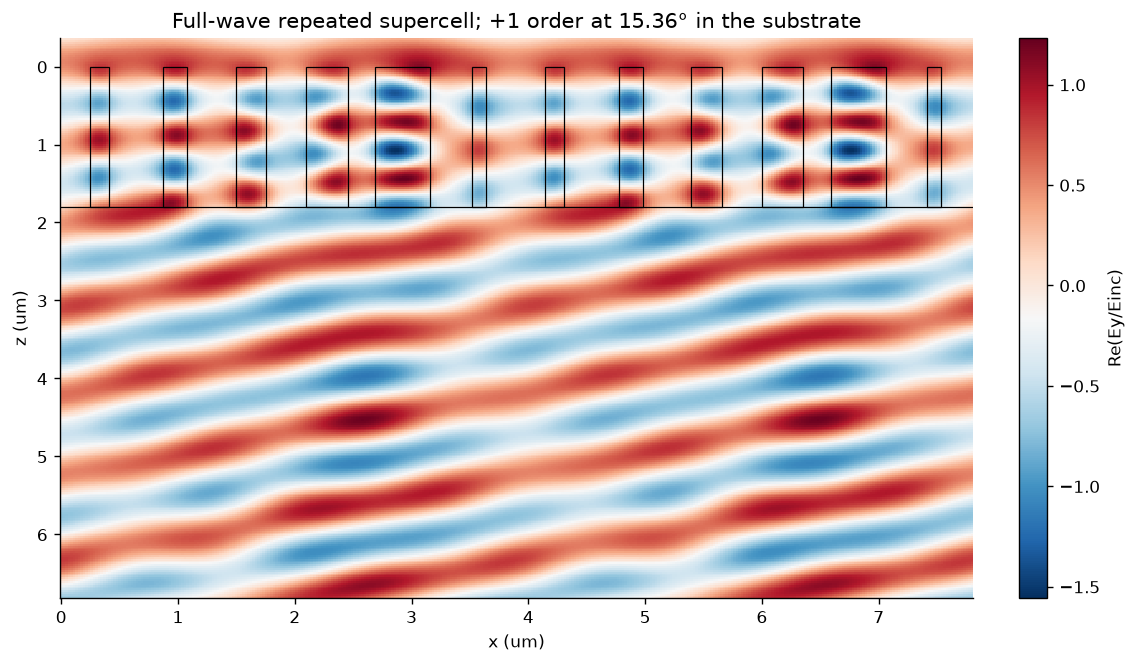
6. Export a reproducible synthesis record
The JSON preserves the extended library, phase-offset selection, geometry sequences, full-wave and local-mask order powers, convergence, source hashes, and validity limits. The separate audit script adds identical-cell embedding, mirror reversal, fine-order checks, and grcwa raster refinements. The chosen performance belongs to this ideal, infinitely periodic, lossless TE geometry. No broadband, fabrication, finite-device, or independent FEM/FDTD validation is implied.
metadata=dict(topic_id='ms-05-beam-steering',solver=SOLVER_VERSION,units='micrometers/degrees',time_convention='exp(-i omega t)',spatial_convention='exp(i k.r)',phase_references={'r':'z=0','t':'z=common height'},pitch_um=PITCH_UM,period_um=PERIOD_UM,wavelength_um=WAVELENGTH_UM,n_incident=REFERENCE.n_incident,n_substrate=REFERENCE.n_substrate,n_ridge=REFERENCE.n_ridge,n_gap=REFERENCE.n_gap,angle_deg=REFERENCE.angle_deg,library_parameters=asdict(replace(REFERENCE,height_um=EXTENDED_HEIGHT_UM)),library_phase_references={'r':'z=0','t':'z=height'},target_order=1,target_angle_deg=target_angle,half_order=M_FINAL,check_half_order=M_CHECK,library_half_order=M_LIBRARY,library_check_half_order=M_LIBRARY_CHECK,minimum_T=MINIMUM_T,selection='361 fixed global offsets; minimize circular phase RMS using unit-cell data only',source_sha256={name:hashlib.sha256((ROOT/'simulations'/name).read_bytes()).hexdigest() for name in ['unit_cell_te.py','metasurface_synthesis.py']},environment=dict(python=platform.python_version(),numpy=np.__version__,scipy=scipy.__version__),limits=['1D TE, real constant dielectric indices','Infinite periodic supercell','Common ridge height within each design','No FEM/FDTD or experiment','Focusing and polarization are separate scalar/Jones models'])
output=dict(metadata=metadata,height_screen=screen,extended_library=extended,selection={name:{k:v for k,v in choice.items() if k!='selected'} for name,choice in [('limited',limited),('expanded',expanded)]},cases=cases,convergence=convergence)
(DATA/'beam-steering.json').write_text(json.dumps(output,indent=2)+'\n',encoding='utf-8')
with (DATA/'extended-library.csv').open('w',newline='',encoding='utf-8') as handle:
    writer=csv.DictWriter(handle,fieldnames=list(extended[0]));writer.writeheader();writer.writerows(extended)
print('Saved beam-steering.json and extended-library.csv')
print('Expanded target-order power:',cases[1]['target_T'],'conditional transmitted fraction:',cases[1]['conditional_target_fraction'])
Saved beam-steering.json and extended-library.csv
Expanded target-order power: 0.8553565666096787 conditional transmitted fraction: 0.9385157769011392
Interpretation and exercises
Explain why the allowed positive order has zero amplitude for identical ridges. Explain why reversing the sequence reverses the strong outgoing order. Compare incident-normalized power and power conditional on transmission. Identify where the local mask’s power account differs from the Maxwell result. Change a target order or period and redo order enumeration and convergence. Evaluate a changed geometry with a fresh solve rather than treating it as a verified prediction.
References: Yu et al. (2011), RCWA foundation, and grcwa documentation.
- Yu, N., Genevet, P., Kats, M. A., Aieta, F., Tetienne, J.-P., Capasso, F., & Gaburro, Z. (2011). Light Propagation with Phase Discontinuities: Generalized Laws of Reflection and Refraction. Science, 334(6054), 333–337. 10.1126/science.1210713
- Moharam, M. G., & Gaylord, T. K. (1981). Rigorous coupled-wave analysis of planar-grating diffraction. Journal of the Optical Society of America, 71(7), 811–818. 10.1364/JOSA.71.000811